Professor Glenn A. Okun
Russia, Iran and the Houthis, a great name for a 1960s revival band, is playing its greatest hits, “Helter Skelter” and “Gimme Shelter”. These aggressors, jointly and severally, have been attempting to use warfare to advance their economic and ideological ambitions, respectively. While they may have failed to achieve these objectives, they have caused economic damage in the form of heightened inflation. Their only hope is that the financial pain will force their adversaries to acquiesce, prioritizing economic over political goals. The energy sector remains the sole beneficiary of these conflicts.
This week the band turned up the volume. The September consumer price index came in hotter than expected, driven almost entirely by fuel. Over the weekend, the Houthis struck Riyadh’s airport twice and reportedly hit the headquarters of Saudi Aramco. And in Eastern Europe, a presidential “energy cease-fire” between Russia and Ukraine lasted roughly as long as it took to post it. Each development is a reminder that, in this conflict, the price of a gallon of diesel is a weapon, and the target is the American voter three weeks before the midterm elections.
Helter Skelter
Saturday’s missile strike on King Khalid International Airport killed at least a dozen people, including an American, and injured more than three hundred. The Houthis returned Sunday evening, setting Terminal Four ablaze, and Riyadh moved its schools online. Roughly eighty-five percent of flights were canceled on the eve of the World Petroleum Congress, which the kingdom is hosting this week. It is hard to imagine a more pointed message to the world’s oil executives.
This is not an isolated incident but a campaign. The Houthis claimed missile and drone strikes on Aramco facilities in late September, and again in early October on sites in Riyadh and the Khurais oil field, with smoke visibly rising from a refinery south of the capital. Saudi Arabia’s benchmark stock index fell as much as one percent on Sunday, with Aramco and Saudi National Bank among the decliners. Riyadh has promised to retaliate; asked whether the United States would join, President Trump replied, “We may. We’re going to look at it.”
The economics explain why the market is nervous. Before the war, about 21.6 million barrels a day moved through the Strait of Hormuz; in the second quarter, the U.S. Energy Information Administration reported that the volume collapsed to 4.9 million. Saudi Arabia’s escape hatch is the East-West pipeline to Yanbu on the Red Sea, which can carry seven million barrels a day, but limited capacity at the Yanbu terminal held actual crude and product shipments to 3.5 to 4 million barrels a day between April and July. The bypass route, in other words, runs straight through the Houthis’ neighborhood. A successful strike on Yanbu or on Red Sea tanker traffic would remove the last major workaround, and analysts estimate that could push Brent past $120.
Brent front-month futures are already back above $106 a barrel, and the contract for delivery six months out has hit a record. That second number is the more telling one: investors have abandoned the notion that this conflict will be over soon. Meanwhile, Iran is rebuilding its missile and drone arsenal, fortifying the Natanz and Pickaxe Mountain nuclear sites, threatening the United Arab Emirates, regional data centers and undersea cables, and stepping up attacks on tankers in the Gulf. At least three commercial vessels were hit over the weekend in and around the strait. The U.S. has a third carrier strike group heading for the region, and Mr. Trump has said only that he will not resume strikes before the midterms.
Back in the U.S.S.R.
The second front of the energy war is being fought over refineries. Ukraine has spent months striking Russian refining capacity, arguing correctly that oil revenue finances Moscow’s war. Russia has answered by pounding Ukraine’s power and gas grid. Mr. Trump, who has blamed the Ukrainian strikes for the global diesel shortage, intervened twice in three days. On October 9, Washington announced a deal for Russia to release more than 300,000 tonnes of diesel immediately and 1.5 million tonnes more over time, backed by a temporary Treasury license lifting sanctions on Russian diesel imports. On October 11, he declared on Truth Social that “effective immediately there is an ENERGY CEASEFIRE” between the two sides. “Both parties have agreed. Do not break it!”
Within hours, according to President Volodymyr Zelensky, Russia launched a targeted strike on Ukrainian power and gas facilities. “For now, this is Putin’s answer to Trump,” he said. Neither combatant has confirmed the deal, and Mr. Zelensky, facing the prospect of reduced American arms deliveries, has said only that Ukraine would respect an energy cease-fire if Russia did the same.
The Russian diesel is a drop in the ocean of supply. It equals roughly three-quarters of one day’s American consumption. Diesel, which hit a record $6.52 a gallon in September, has drifted down only to about $6.28. Markets appear to read the deal less as a breakthrough than as a sign of desperation.
For Moscow, by contrast, every dollar matters. A bipartisan group of seven senators has demanded that the administration reverse course, noting that a 2022 law bans Russian energy imports and that the U.S. “should not provide Putin with a financial lifeline while Russia continues to kill Ukrainian civilians.” It is worth recalling that Treasury Secretary Scott Bessent told his confirmation hearing in January 2025 that sanctions on Russia were not strong enough, and that the previous administration had been “worried about raising U.S. energy prices during an election season.” Election seasons, it turns out, are bipartisan.
Gimme Shelter
The Labor Department reported Wednesday that consumer prices rose 3.7% in September from a year earlier, up from 3.4% in August and above the 3.6% consensus. Gasoline rose 9.1% in a single month and is up 34% from a year ago. Fuel oil is up 74%. Transportation services rose 0.6% as fuel costs worked their way into freight and airfares. Stock futures turned negative on the release, and the 10-year Treasury yield rose.
However, core inflation, which excludes food and energy, was 2.6%, a tenth above forecasts and a tenth hotter month over month, but hardly a wage-price spiral. Food was flat in September and is up 2.5% for the year, although economists are watching for higher transportation costs to seep into meat and dairy. The aggressors have succeeded in raising the prices voters see on every gas station sign, not the underlying inflation rate that economists target.
This poses a dilemma for the Federal Reserve. On September 16, the Fed raised rates for the first time in three years, by a quarter point to a range of 3.75% to 4.00%, and 16 of 18 officials indicated that at least one more increase may be appropriate this year.
Higher interest rates cannot reopen the Strait of Hormuz, intercept a Houthi missile or refine a barrel of diesel. Nor will they do much to slow the data-center boom, which is adding its own inflationary pressure through semiconductors, transformers and electricity. As Cleveland Fed President Beth Hammack noted, hyperscalers show “much less price sensitivity and much greater sense of urgency around delivery.”
The Fed’s concern, after five years of above-target inflation, is expectations. Americans are fed up with rising prices, and a supply shock that persists long enough can become a demand-side problem as businesses discover they can pass costs along to consumers who are still spending. Real consumer spending was up 2.6% from a year earlier in August, buoyed by low unemployment and record stock prices. The Fed meets again on October 27, one week before the election. It is difficult to recall a rate decision with more political subtext.
Money (That’s What I Want)
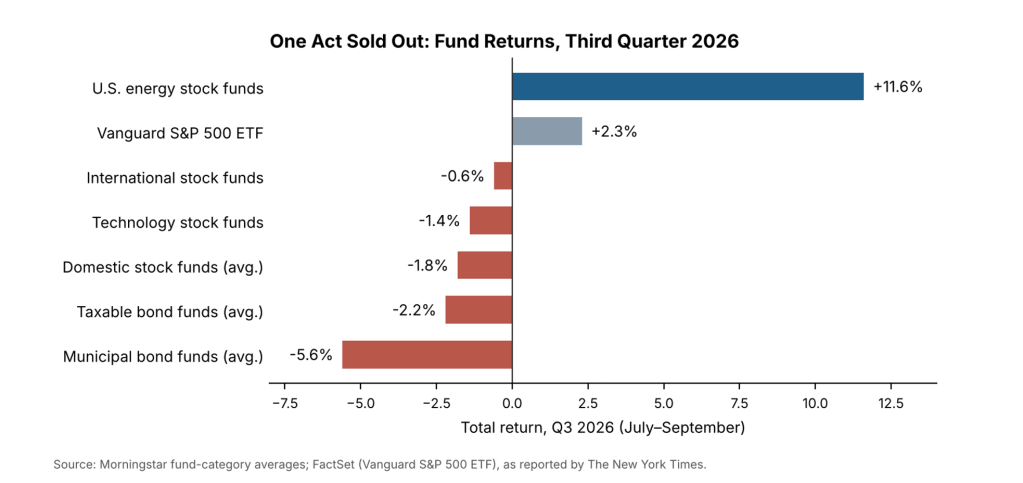
If there is a winner in all of this, it is the energy sector. The average U.S. energy stock fund returned 11.6% in the third quarter, according to Morningstar, while the average domestic stock fund lost 1.8%, taxable bond funds lost 2.2% and municipal bond funds fell 5.6%. Technology funds, the consensus favorite at the start of the year, slipped 1.4%.
Is the band concluding its farewell tour or starting a longer residency? The aggressors’ strategy rests on a simple wager: that Western voters will trade geopolitical goals for cheaper fuel. The diesel waiver suggests the wager is not unreasonable. But the strategy has a cost for them as well. Iran’s economy is under a tightening blockade, Russia’s windfall is modest and temporary, and the Houthis risk pushing a reluctant Saudi Arabia into the arms of the hawks.
Trump’s folly in Iran has destabilized the Middle East, a region with fragile geopolitical foundations. Russia cannot easily extricate itself from its self-induced quagmire in Ukraine. The likelihood of sustained conflicts and high energy prices primarily benefits the energy sector, including the Rabid Capitalist’s oil and gas majors portfolio (BP, SHEL, TTE and XOM). There are no changes to our investment strategy at this time.
| DISCLAIMER: The Rabid Capitalist and all of its associated properties are owned by Cognitor Consulting LLC (“Cognitor”). Cognitor is a publisher of financial information. |
| Cognitor is not a financial adviser. Cognitor does not guarantee the accuracy or completeness of the information provided in this page. All statements and expressions herein are the sole opinion of the author or paid advertiser. |
| THE INFORMATION CONTAINED ON THIS WEBSITE IS NOT AND SHOULD NOT BE CONSTRUED AS INVESTMENT ADVICE, AND DOES NOT PURPORT TO BE AND DOES NOT EXPRESS ANY OPINION AS TO THE PRICE AT WHICH THE SECURITIES OF ANY COMPANY MAY TRADE AT ANY TIME. THE INFORMATION AND OPINIONS PROVIDED HEREIN SHOULD NOT BE TAKEN AS SPECIFIC ADVICE ON THE MERITS OF ANY INVESTMENT DECISION. INVESTORS SHOULD MAKE THEIR OWN INVESTIGATION AND DECISIONS REGARDING THE PROSPECTS OF ANY COMPANY DISCUSSED HEREIN BASED ON SUCH INVESTORS’ OWN REVIEW OF PUBLICLY AVAILABLE INFORMATION AND SHOULD NOT RELY ON THE INFORMATION CONTAINED HEREIN. INVESTORS SHOULD OBTAIN INDIVIDUAL INVESTMENT ADVICE BASED ON THEIR OWN CIRCUMSTANCES BEFORE MAKING AN INVESTMENT DECISION |
| No statement or expression of opinion, or any other matter herein, directly or indirectly, is an offer or the solicitation of an offer to buy or sell the securities or financial instruments mentioned. |
| The author, publisher or insiders of the publisher may currently have long or short positions in the securities of the companies mentioned herein, or may have such a position in the future (and therefore may profit from fluctuations in the trading price of the securities). To the extent such persons do have such positions, there is no guarantee that such persons will maintain such positions. |
| Any projections, market outlooks or estimates herein are forward looking statements and are inherently unreliable. They are based upon certain assumptions and should not be construed to be indicative of the actual events that will occur. Other events that were not taken into account may occur and may significantly affect the returns or performance of the securities discussed herein. The information provided herein is based on matters as they exist as of the date of preparation and not as of any future date, and Cognitor undertakes no obligation to correct, update or revise the information in this document or to otherwise provide any additional material. |
| Cognitor does not accept any liability whatsoever for any direct or consequential loss howsoever arising, directly or indirectly, from any use of the information contained herein. |
| By using the Site or any related social media account, you are indicating your consent and agreement to this disclaimer and our terms of use. Unauthorized reproduction of this newsletter or its contents by photocopy, facsimile or any other means is illegal and punishable by law. |
| Cognitor publishes content through WordPress, an email newsletter platform. By accessing Cognitor’s content, you agree to be bound by the Terms of Use and Privacy Policy, in effect at the time you access this website or any page thereof or any of Cognitor’s content. The Terms of Use and Privacy Policy may be amended from time to time. Nothing on this website or Cognitor constitute an offer to sell, or a solicitation of an offer to buy or subscribe for, any securities to any person in any jurisdiction where such an offer or solicitation is against the law or to anyone to whom it is unlawful to make such offer or solicitation. Cognitor is not an underwriter, broker-dealer, Title III crowdfunding portal or a valuation service and does not engage in any activities requiring any such registration. Cognitor does not provide advice on investments or structure transactions. Offerings made under Regulation A under the U.S. Securities Act of 1933, as amended (the “Securities Act”) are available to U.S. investors ONLY who are “accredited investors” as defined by Rule 501 of Regulation D under the Securities Act well as non-accredited investors, who are subject to certain investment limitations as set forth in Regulation A under the Securities Act. In order to invest in Regulation A offerings, investors may be asked to fill out a certification and provide necessary documentation as proof of your income and/or net worth to verify that you are qualified to invest in offerings posted on this website. All securities listed on this site are being offered by, and all information included on this site is the responsibility of, the applicable issuer of such securities. Cognitor does not verify the adequacy, accuracy or completeness of any information. Neither Cognitor nor any of its officers, directors, agents and employees makes any warranty, express or implied, of any kind whatsoever related to the adequacy, accuracy, valuations of securities or completeness of any information on this site or the use of information on this site. Neither Cognitor nor any of its directors, officers, employees, representatives, affiliates or agents shall have any liability whatsoever arising from any error or incompleteness of fact, or lack of care in the preparation of, any of the materials posted on this website. Investing in securities, especially those issued by start-up companies, involves substantial risk. investors should be able to bear the loss of their entire investment and should make their own determination of whether or not to make any investment based on their own independent evaluation and analysis. |


Leave a Reply