Professor Glenn A. Okun
Last week, Elon Musk unveiled the Tesla Roadster. It is another in a long line of stage-worthy product introductions by Tesla that inevitably will not be introduced as a commercial product. Will investors continue to blindly follow this era’s P.T. Barnum?
Barnum would have admired the staging. On October 15, the new Roadster appeared in a cloud of compressed air at SpaceX’s rocket test site in McGregor, Texas. It was Mr. Musk’s personal brand distilled to a single evening: an epic announcement packed with grandiose promises, and a magic act that kept the audience staring at the smoke while the real trouble happened backstage. Backstage, at headquarters, Elon is surrounded by misfit toys: a humanoid robot with a repeatedly delayed reveal, a Cybercab production line devoid of meaningful units in service, and a “Full Self-Driving” system that still requires human supervision that is nearly a decade overdue.
The Greatest Show on Earth
The Roadster demonstrated its novel but useless things capabilities. It raced upside down, clinging to a giant inverted ramp like a Hot Wheels toy. It hopped over a Model 3, a Model Y, a Cybertruck, a Tesla Semi and a Cybercab. It flipped in midair and floated back to earth on air thrusters, landing on all four wheels and momentarily disappearing in a puff of gas.
What the Roadster did not do was provide a price, or a credible delivery date. Mr. Musk’s latest toy is the most literal case of vaporware in the history of technology: a product you cannot buy, propelled by actual vapor.
Step Right Up
Tesla’s status as a technology company is largely limited to its valuation multiple. The firm’s primary function has been to issue press releases proclaiming bold innovations, and those assertions have mostly been unfulfilled promises.
| Year | The promise | Where it stands, October 2026 |
| 2010 | An electric car | Delivered. The Model S and its successors are real cars that real people drive. The one genuine success. |
| 2016 | A driverless car | Every Tesla was said to have the hardware for full autonomy. The software is still sold as “Full Self-Driving (Supervised).” |
| 2016 | A $25,000 EV | Never built. The cheapest Model Y and Model 3 trims remain well above that mark. |
| 2017 | A roadster | Unveiled for a second time last week. Production: “2028, actually.” No price. |
| 2019 | A robotaxi service | A small geofenced service in Austin, Dallas and Houston, with roughly 17 cars across all three cities as of April. |
| 2023 | A robot car | Cybercab production began at Giga Texas in April; Musk himself warned the ramp would be “agonizingly slow.” |
| Mid-2023 | Artificial-intelligence services | Tesla disbanded its Dojo supercomputer team in 2025; AI remains a narrative rather than a revenue line. |
| 2024 | A robot car-sharing service | Owners still cannot add their cars to a Tesla robotaxi network. |
With a record of one actual success out of eight announced radical innovation “triumphs,” one would have expected Tesla’s credibility to have been destroyed. As subscribers can see in the chart below, the company’s reputation has been damaged, but not yet ruined.
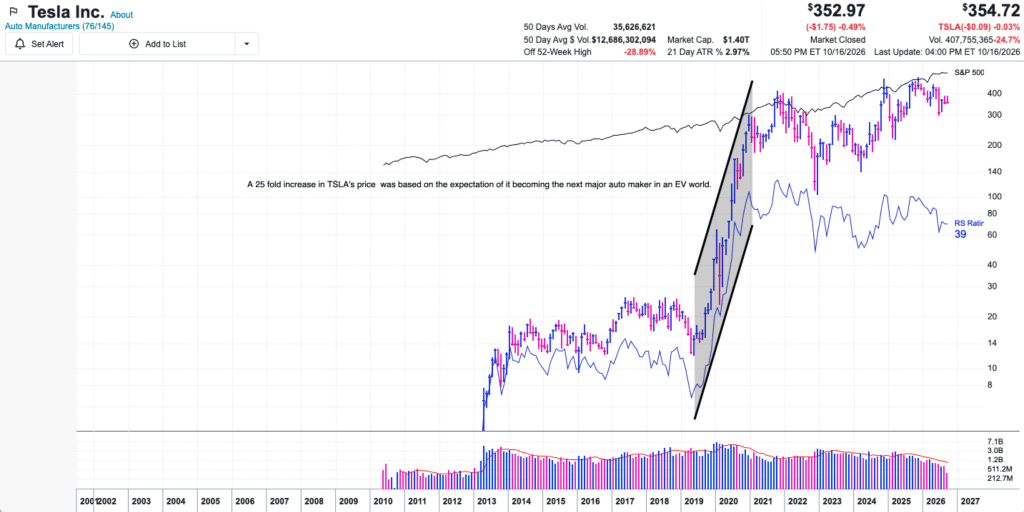
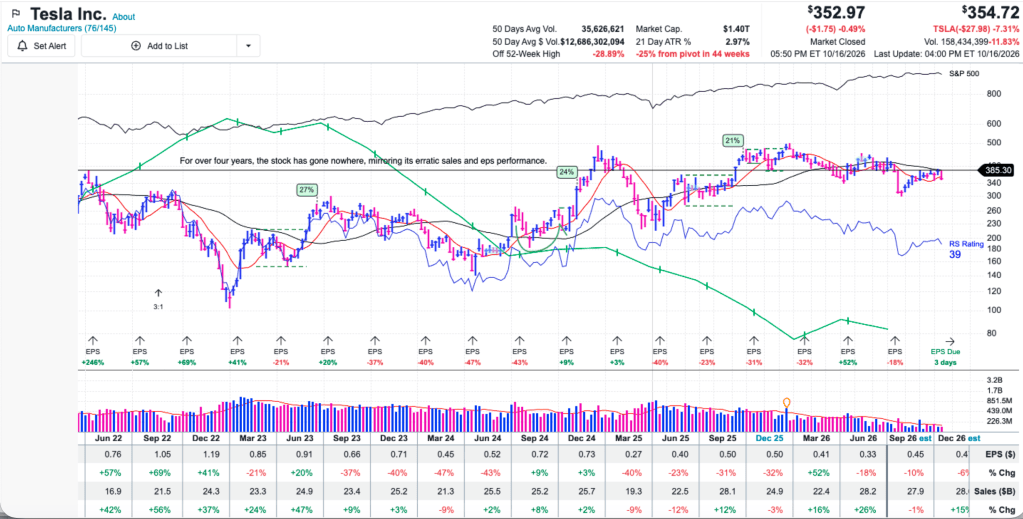
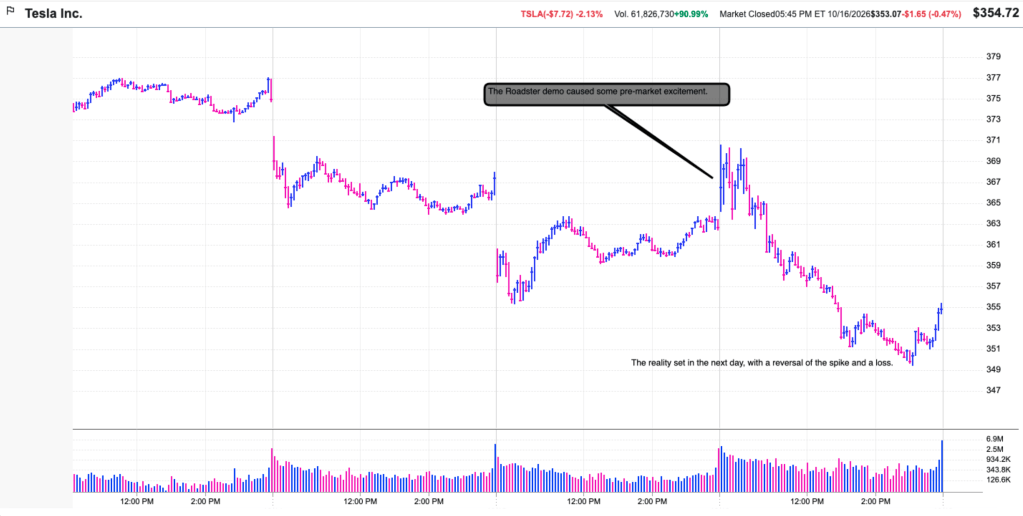
Friday’s trading was a case study in the Barnum effect. Tesla shares jumped almost five percent in the premarket on the strength of the overnight spectacle. By the closing bell, the audience had filed out of the tent and dumped the stock, finishing the day down over two percent, at $354.72. Through the start of October, the shares had lost more than fifteen percent of their value this year.
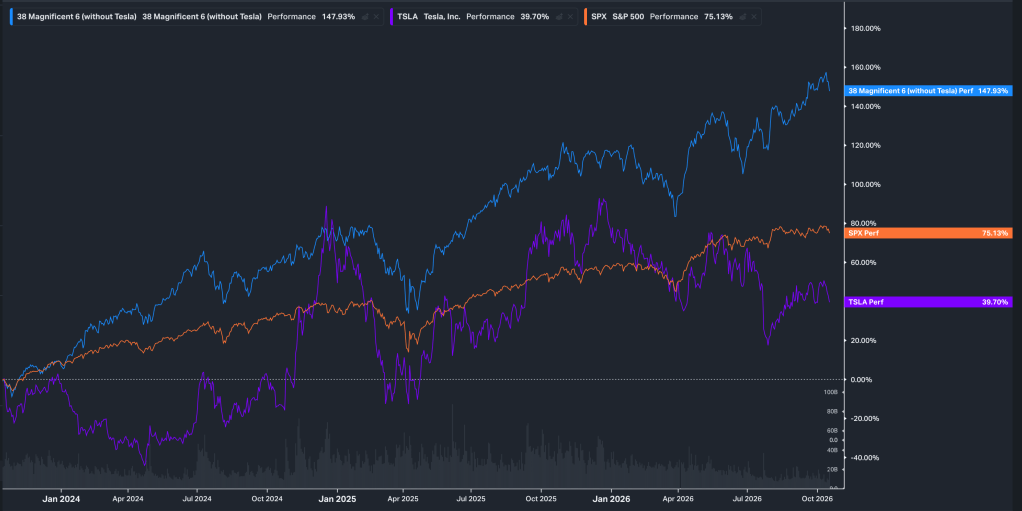
Tesla has also surrendered much of the gain associated with the 2024 presidential election. There are good reasons to believe that President Trump’s policies will hurt the company. His electric vehicle (“EV”) policy canceled the $7,500 federal EV tax credit as of September 30, 2025, raising the effective price of every Tesla sold in America. The same legislation eliminated the fuel-economy penalties that once forced rival automakers to buy Tesla’s regulatory credits, a high-margin revenue source the company has quietly depended on for years. Tesla cited lower regulatory-credit revenue as a drag on second-quarter operating income.
The deliveries tell the same story. Tesla delivered 486,532 vehicles in the third quarter, beating Wall Street’s estimate but falling about two percent from the record 497,099 in the same quarter last year, when buyers rushed to beat the expiration of the tax credit.
Then and Now
The Roadster pales in comparison to Musk’s promises. In 2017, he stated that it would sprint from zero to sixty miles per hour in 1.9 seconds, go 620 miles on a charge, seat four, cost $200,000 and reach customers in 2020.
Tesla Roadster: promise versus reality
| Promised in 2017 | Revealed in 2026 | |
| Range | 620 miles | “Over 300 miles” |
| Seating | Four (2+2) | Two; the Rocket version seats one |
| 0–60 mph | 1.9 seconds | Under 1.6 seconds (Performance); under 0.9 seconds (Thrust) |
| Price | $200,000 base; $250,000 Founders Series | Not announced for any version |
| Customer deliveries | 2020 | Production in “2028, actually” |
| Deposit | $50,000 | $50,000 ($5,000 now, $45,000 within 10 days) |
Sources: Tesla, Electrek (Oct. 15, 2026), Finviz/Zacks.
Several versions of the Roadster may not be driven legally on a road. Asked whether the car would be street legal, Mr. Musk replied, “Yeah, yeah. Depends on your street.” As Scott Miller, an aviation lecturer at San Jose State University, reminded Wired, the Federal Aviation Administration has jurisdiction over any machine that leaves the surface of the earth. Meanwhile, the high-pressure carbon-fiber tanks Tesla has packed into every available void in the car are a cousin of the vessels implicated in several SpaceX rocket failures, as TechCrunch noted.
A Sucker Born Every Minute
Behind the smoke, the fundamentals are deteriorating. In the second quarter, Tesla’s revenue rose twenty-six percent to $28.24 billion, yet operating income fell fifty-seven percent to $398 million, an operating margin of just 1.4%. Capital spending jumped one hundred and forty-two percent to $5.79 billion, and free cash flow was negative $1.09 billion. Tesla trades at roughly 270 times annualized quarterly earnings, a valuation that relies on Musk’s unfulfilled promises of robots, robotaxis and AI. Ford and General Motors, which actually sell cars at a profit, trade at a small fraction of that multiple.
The Show Must Go On
Some Tesla shareholders now openly hope a merger will rescue a stock whose automotive business is stalling. A Tesla-SpaceX merger may simply defer the day of reckoning for shareholders.
| DISCLAIMER: The Rabid Capitalist and all of its associated properties are owned by Cognitor Consulting LLC (“Cognitor”). Cognitor is a publisher of financial information. |
| Cognitor is not a financial adviser. Cognitor does not guarantee the accuracy or completeness of the information provided in this page. All statements and expressions herein are the sole opinion of the author or paid advertiser. |
| THE INFORMATION CONTAINED ON THIS WEBSITE IS NOT AND SHOULD NOT BE CONSTRUED AS INVESTMENT ADVICE, AND DOES NOT PURPORT TO BE AND DOES NOT EXPRESS ANY OPINION AS TO THE PRICE AT WHICH THE SECURITIES OF ANY COMPANY MAY TRADE AT ANY TIME. THE INFORMATION AND OPINIONS PROVIDED HEREIN SHOULD NOT BE TAKEN AS SPECIFIC ADVICE ON THE MERITS OF ANY INVESTMENT DECISION. INVESTORS SHOULD MAKE THEIR OWN INVESTIGATION AND DECISIONS REGARDING THE PROSPECTS OF ANY COMPANY DISCUSSED HEREIN BASED ON SUCH INVESTORS’ OWN REVIEW OF PUBLICLY AVAILABLE INFORMATION AND SHOULD NOT RELY ON THE INFORMATION CONTAINED HEREIN. INVESTORS SHOULD OBTAIN INDIVIDUAL INVESTMENT ADVICE BASED ON THEIR OWN CIRCUMSTANCES BEFORE MAKING AN INVESTMENT DECISION |
| No statement or expression of opinion, or any other matter herein, directly or indirectly, is an offer or the solicitation of an offer to buy or sell the securities or financial instruments mentioned. |
| The author, publisher or insiders of the publisher may currently have long or short positions in the securities of the companies mentioned herein, or may have such a position in the future (and therefore may profit from fluctuations in the trading price of the securities). To the extent such persons do have such positions, there is no guarantee that such persons will maintain such positions. |
| Any projections, market outlooks or estimates herein are forward looking statements and are inherently unreliable. They are based upon certain assumptions and should not be construed to be indicative of the actual events that will occur. Other events that were not taken into account may occur and may significantly affect the returns or performance of the securities discussed herein. The information provided herein is based on matters as they exist as of the date of preparation and not as of any future date, and Cognitor undertakes no obligation to correct, update or revise the information in this document or to otherwise provide any additional material. |
| Cognitor does not accept any liability whatsoever for any direct or consequential loss howsoever arising, directly or indirectly, from any use of the information contained herein. |
| By using the Site or any related social media account, you are indicating your consent and agreement to this disclaimer and our terms of use. Unauthorized reproduction of this newsletter or its contents by photocopy, facsimile or any other means is illegal and punishable by law. |
| Cognitor publishes content through WordPress, an email newsletter platform. By accessing Cognitor’s content, you agree to be bound by the Terms of Use and Privacy Policy, in effect at the time you access this website or any page thereof or any of Cognitor’s content. The Terms of Use and Privacy Policy may be amended from time to time. Nothing on this website or Cognitor constitute an offer to sell, or a solicitation of an offer to buy or subscribe for, any securities to any person in any jurisdiction where such an offer or solicitation is against the law or to anyone to whom it is unlawful to make such offer or solicitation. Cognitor is not an underwriter, broker-dealer, Title III crowdfunding portal or a valuation service and does not engage in any activities requiring any such registration. Cognitor does not provide advice on investments or structure transactions. Offerings made under Regulation A under the U.S. Securities Act of 1933, as amended (the “Securities Act”) are available to U.S. investors ONLY who are “accredited investors” as defined by Rule 501 of Regulation D under the Securities Act well as non-accredited investors, who are subject to certain investment limitations as set forth in Regulation A under the Securities Act. In order to invest in Regulation A offerings, investors may be asked to fill out a certification and provide necessary documentation as proof of your income and/or net worth to verify that you are qualified to invest in offerings posted on this website. All securities listed on this site are being offered by, and all information included on this site is the responsibility of, the applicable issuer of such securities. Cognitor does not verify the adequacy, accuracy or completeness of any information. Neither Cognitor nor any of its officers, directors, agents and employees makes any warranty, express or implied, of any kind whatsoever related to the adequacy, accuracy, valuations of securities or completeness of any information on this site or the use of information on this site. Neither Cognitor nor any of its directors, officers, employees, representatives, affiliates or agents shall have any liability whatsoever arising from any error or incompleteness of fact, or lack of care in the preparation of, any of the materials posted on this website. Investing in securities, especially those issued by start-up companies, involves substantial risk. investors should be able to bear the loss of their entire investment and should make their own determination of whether or not to make any investment based on their own independent evaluation and analysis. |


Leave a Reply